
The graphs below provide information on global population figures and figures for urban populations in different world regions.
Summarise the information by selecting and reporting the main features, and make comparisons where relevant.

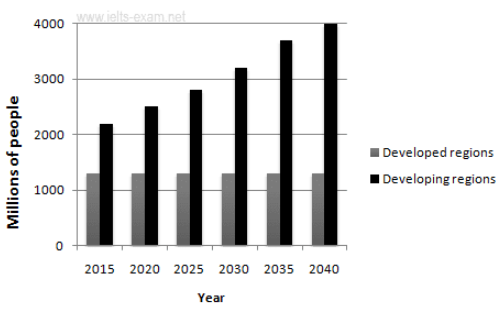
(Courtesy of ielts-exam.net)
The presented graphs demonstrate changes on1 Earth population from 19 century to 21 century2 and show difference3 between developed and developing countries.
Analysing the first we4 can conclude that 1800 the number had stable growth, but after 1940 marks went up rapidly. However the graph predicts that in 2040 points will reach a pick5 in and level out at more than 8000 million people. After the top the decrease will be dramatically6 as the growth was and in 2100 the number will fall to around 6000 million people.
The other graph presents the numbers of urban citizens in two regions. As we4 can see in developed parts of the world marks remain constant during the whole period and amount to a little bit more than 1000 million citizens. In the same time there is a permanent increase in developing countries that leads to a7 4000 million urban population in 2100.
According to graphs the growth will last until 2040. Also expects8 the increase of the number of city dwellers in developing countries.
Нумерация ошибок соответствует маркировке в тексте. Рекомендуемые исправления и изменения в тексте подчёркнуты.
- Changes in/of Earth population
- Тут у нас порядковые числительные, поэтому нужен определённый артикль. Слово century во втором случае можно опустить: «… from the 19th to 21st century»
- «The difference between» — слово difference является исчисляемым, тут мы говорим об определённом различии.
- Избегайте формулировок «мы», «нам» и т.д.
- Peak?
- Тут нам нужно прилагательное, а не наречие: «… the decrease will be dramatic«
- Слово population не используется с неопределённым артиклем в подобном контексте, т.к. является неисчесляемым.
- Во-первых, не стоит начинать предложение с союза. Во-вторых, у нас тут нет подлежащего — неясно, к чему относится слово «expects». Если это безличное предложение («Ождиается, что количество … увеличится»), то можно написать так: «Also, the number of city dwellers in developing countries is expected to increase».
| Аспект | Оценка |
| TA | 7.0 |
| C&C | 6.0 |
| Grammar | 6.0 |
| Vocabulary | 7.5 |
| Общая оценка: 7.0 Критерии оценки |
|